The invisible threshold: why concussion can lead to prolonged absenteeism
A concussion is often seen as a relatively minor injury. Take a few days of rest and then continue. Yet in practice it appears that recovery is not always that easy. For some employees, complaints can last for weeks or even months, with consequences for work, employability and reintegration.
Recent figures from ArboNed and HumanCapitalCare, cited by RTL News, show that the number of employees who end up at the company doctor with a concussion has increased by 64% in the past three years. The cause of this increase has not yet been determined, but the figures do underline that the impact of concussion on work must be taken seriously.
The consequences are often invisible
Different from many other injuries, the consequences of a concussion are usually not visible to the environment. An employee can look healthy, while daily work requires great effort.
Many complaints are:
- Fatigue that does not disappear after a night of sleep
- Concentration problems
- Problems with memory and attention
- Headache
- Dizzy
- Overstimulation due to light, sound or crowds
- Difficulty with screen work
- Reduced mental stressfulness
It is precisely because these complaints are not immediately visible that there is a risk that they will be underestimated by the environment or by the employee himself.
Why work resumption sometimes proves difficult
Work often calls for concentration, processing information, switching between tasks and dealing with incentives. These are exactly the functions that may be temporarily disrupted after a concussion.
Many employees want to resume their work as quickly as possible. Based on their involvement with colleagues or sense of responsibility, they often immediately try to function at their old level again. However, this can lead to a decline in the recovery process.
The challenge therefore lies not only in reducing complaints, but above all in finding a good balance between load and load capacity.
The changed vision of recovery
The medical insights surrounding concussions have changed in recent years. Where long-term rest used to be central, active recovery and a gradual build-up of daily activities and work are now more often considered. According to experts, this may partly explain why employees are more likely to appear at the company doctor.
Complete inactivity is usually not the most effective approach. At the same time, too rapid a build-up can actually worsen complaints. That is why customization is central.
What helps with recovery and reintegration?
Although every situation is different, a number of principles appear to be important:
1. Start small
Start work that requires limited mental effort. Consider light administrative tasks without high time pressure or complex decision-making.
2. Build up gradually
Increase working hours and responsibilities step by step. A rapid return to the old working level does not always lead to sustainable recovery.
3. Plan recovery moments
Short work blocks alternating with rest moments can help prevent overload.
4. Accept temporary relapse
Recovering after concussion rarely proceeds completely linearly. A period with more complaints does not automatically mean that recovery stagnates.
5. Keep evaluating
Taxability may differ per week. Regular coordination between employee, employer and company doctor therefore remains important.
The role of the employer
Employers, HR professionals and case managers play an important role in sustainable recovery. A safe working environment in which workers can indicate their limits contributes to a successful return to work.
Important are:
- Timely involvement of the company doctor
- A realistic Plan of Action
- Regular evaluation moments
- Clear communication about expectations
- Space for customization in work and working hours
By providing timely support, temporary complaints can be prevented from developing into long-term failure.
When additional support is needed
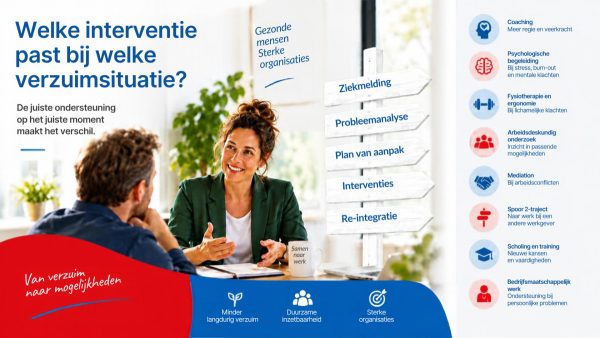
When recovery takes longer than expected, additional interventions can contribute to the recovery process. Depending on the situation, these may be, for example:
- Coaching aimed at load capacity
- Psychological guidance
- Support in stimulus and energy management
- Labour-oriented guidance
- Reintegration support
The aim of these interventions is not only to reduce complaints, but above all to promote sustainable participation and return to work.
Conclusion
A concussion is more than a temporary complaint that goes away on its own. For some workers, the consequences may be noticeable for long periods of time, with an impact on work, functioning and recovery.
The recent rise in workers who end up with a concussion at the company doctor shows that this subject deserves attention within absence and reintegration pathways. Good guidance, realistic expectations and timely support can make the difference between long-term dropout and a sustainable return to work.
In the event of a concussion with long-lasting consequences for work and functioning, it is Neuropsychologisch Research appropriate to map the cognitive and emotional impact and determine the actual load capacity. This helps to draw up a targeted reintegration plan and workplace adjustments.
Sources
- RTL News – "More people with concussions to company doctor, cause remains mysterious" [rtl.nl]
- ArboNed and HumanCapitalCare – data cited in RTL News coverage [rtl.nl]
- Stichting Concussion – information about long-term complaints and labor participation after brain injury [stichtingh...hudding.nl]
Know more about interventions that can contribute to recovery, sustainable employability and reintegration? View the intervention offer from PoortwachterDirect or contact one of our advisors.